
Mass suicide at Jonestown
On November 18, 1978, Peoples Temple founder Jim Jones leads hundreds of his followers in a mass murder-suicide at their agricultural commune in a remote part of the South American nation of Guyana. Many of Jones’ followers willingly ingested a poison-laced punch while others were forced to do so at gunpoint. The final death toll at Jonestown that day was 909; a third of those who perished were children.
Jim Jones was a charismatic churchman who established the Peoples Temple, a Christian sect, in Indianapolis in the 1950s. He preached against racism, and his integrated congregation attracted many African Americans. In 1965, he moved the group to Northern California, settling in Ukiah and after 1971 in San Francisco. In the 1970s, his church was accused by the media of financial fraud, physical abuse of its members and mistreatment of children. In response to the mounting criticism, the increasingly paranoid Jones invited his congregation to move with him to Guyana, where he promised they would build a socialist utopia. Three years earlier, a small group of his followers had traveled to the tiny nation to set up what would become Jonestown on a tract of jungle.
Jonestown did not turn out to be the paradise their leader had promised. Temple members worked long days in the fields and were subjected to harsh punishments if they questioned Jones’ authority. Their passports were confiscated, their letters home censored and members were encouraged to inform on one another and forced to attend lengthy, late-night meetings. Jones, by then in declining mental health and addicted to drugs, was convinced the U.S. government and others were out to destroy him. He required Temple members to participate in mock suicide drills in the middle of the night.
In 1978, a group of former Temple members and concerned relatives of current members convinced U.S. Congressman Leo Ryan, a Democrat of California, to travel to Jonestown and investigate the settlement. On November 17, 1978, Ryan arrived in Jonestown with a group of journalists and other observers. At first the visit went well, but the next day, as Ryan’s delegation was about to leave, several Jonestown residents approached the group and asked them for passage out of Guyana. Jones became distressed at the defection of his followers, and one of Jones’ lieutenants attacked Ryan with a knife. The congressman escaped from the incident unharmed, but Jones then ordered Ryan and his companions ambushed and killed at the airstrip as they attempted to leave. The congressman and four others were murdered as they boarded their charter planes.
Back in Jonestown, Jones commanded everyone to gather in the main pavilion and commit what he termed a “revolutionary act.” The youngest members of the Peoples Temple were the first to die, as parents and nurses used syringes to drop a potent mix of cyanide, sedatives and powdered fruit juice into children’s throats. Adults then lined up to drink the poison-laced concoction while armed guards surrounded the pavilion.
When Guyanese officials arrived at the Jonestown compound the next day, they found it carpeted with hundreds of bodies. Many people had perished with their arms around each other. A few residents managed to escape into the jungle as the suicides took place, while at least several dozen more Peoples Temple members, including several of Jones’ sons, survived because they were in another part of Guyana at the time.

1990S
1991
Terry Waite released after four-year kidnapping in Lebanon
Shiite Muslim kidnappers in Lebanon free Anglican Church envoy Terry Waite after more than four years of captivity. Waite, looking thinner and his hair grayer, was freed along with American educator Thomas M. Sutherland after intense negotiations by the United Nations.

SPORTS
1966
L.A. Dodgers’ ace pitcher Sandy Koufax retires
On November 18, 1966, Sandy Koufax, the ace pitcher for the Los Angeles Dodgers, retires from baseball. He was just 30 years old, and he was retiring after a great season–he’d led the Dodgers to a National League pennant and won his third Cy Young award.

19TH CENTURY
1883
Railroads create the first time zones
At exactly noon on this day, American and Canadian railroads begin using four continental time zones to end the confusion of dealing with thousands of local times. The bold move was emblematic of the power shared by the railroad companies.

1990S
1999
12 die in bonfire at Texas A&M University
For nearly a century, students at Texas A&M University in College Station, Texas, created a massive bonfire—self-proclaimed to be “the world’s largest”—prior to their school’s annual football game against their archrival, the University of Texas. The beloved pre-game tradition had been canceled only once, in 1963 following the assassination of President John F. Kennedy. Over the years, the bonfire grew so big that its construction became an elaborate project requiring days of work by teams of student volunteers. On two previous occasions, the bonfire had partially collapsed; neither episode had been disastrous. The 1999 bonfire was supposed to require more than 7,000 logs and the labor of up to 70 workers at a time. Just after dawn on November 18, students were working near the top of the 59-foot-high pile (4 feet higher than authorized) when, in the words of Jenny Callaway, a student who was on the stack, “It just snapped.” Without warning, scores of students became caught in the huge log pile. Other students, including Caleb Hill who suffered only broken bones in his 50-foot fall, were lucky enough to fall away from the pile.
CRIME
1996
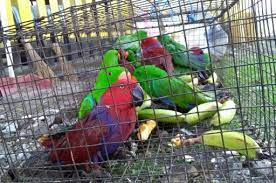
High-profile expert on exotic birds is sentenced for smuggling parrots
Tony Silva, a world-renowned expert and outspoken protector of exotic birds, is sentenced to seven years in prison without parole for leading an illegal parrot smuggling operation. Silva was only one of many to be arrested during “Operation Renegade,”

US GOVERNMENT
1987
Congress issues final report on Iran-Contra scandal
After nearly a year of hearings into the Iran-Contra scandal, the joint Congressional investigating committee issues its final report. It concluded that the scandal, involving a complicated plan whereby some of the funds from secret weapons sales to Iran were used to finance the the Contra war against the Sandinista government in Nicaragua, was one in which the administration of Ronald Reagan exhibited “secrecy, deception, and disdain for the law.”

CIVIL WAR
1863
President Lincoln travels to Gettysburg
On November 18, 1863, President Abraham Lincoln boards a train for Gettysburg, Pennsylvania, to deliver a short speech the following day at the dedication of a cemetery of soldiers killed during the battle there on July 1 to July 3, 1863.

WORLD WAR II
1940
Hitler furious over Italy’s debacle in Greece
On November 18, 1940, Adolf Hitler meets with Italian Foreign Minister Galeazzo Ciano over Mussolini’s disastrous invasion of Greece. Mussolini surprised everyone with a move against Greece; his ally, Hitler, was caught off guard, especially since the Duce had led Hitler to believe he had no such intention. Even Mussolini’s own chief of army staff found out about the invasion only after the fact!

WORLD WAR I
1916
Battle of the Somme ends
On November 18, 1916, British Commander in Chief Sir Douglas Haig calls a halt to his army’s offensive near the Somme River in northwestern France, ending the epic Battle of the Somme after more than four months of bloody conflict.


Comments
Post a Comment