
“A Streetcar Named Desire” opens on Broadway
On December 3, 1947, Marlon Brando’s famous cry of “STELLA!” first booms across a Broadway stage, electrifying the audience at the Ethel Barrymore Theatre during the first-ever performance of Tennessee Williams’ play A Streetcar Named Desire.
The 23-year-old Brando played the rough, working-class Polish-American Stanley Kowalski, whose violent clash with Blanche DuBois (played on Broadway by Jessica Tandy), a Southern belle with a dark past, is at the center of Williams’ famous drama. Blanche comes to stay with her sister Stella (Kim Hunter), Stanley’s wife, at their home in the French Quarter of New Orleans; she and Stanley immediately despise each other. In the climactic scene, Stanley rapes Blanche, causing her to lose her fragile grip on sanity; the play ends with her being led away in a straitjacket.
Streetcar, produced by Irene Mayer Selznick and directed by Elia Kazan, shocked mid-century audiences with its frank depiction of sexuality and brutality onstage. When the curtain went down on opening night, there was a moment of stunned silence before the crowd erupted into a round of applause that lasted 30 minutes. On December 17, the cast left New York to go on the road. The show would run for more than 800 performances, turning the charismatic Brando into an overnight star. Tandy won a Tony Award for her performance, and Williams was awarded the Pulitzer Prize for Drama.
In 1951, Kazan made Streetcar into a movie. Brando, Hunter and Karl Malden (as Stanley’s friend and Blanche’s love interest) reprised their roles. The role of Blanche went to Vivien Leigh, the scenery-chewing star of Gone with the Wind. Controversy flared when the Catholic Legion of Decency threatened to condemn the film unless the explicitly sexual scenes—including the climactic rape—were removed. When Williams, who wrote the screenplay, refused to take out the rape, the Legion insisted that Stanley be punished onscreen. As a result, the movie (but not the play) ends with Stella leaving Stanley.
A Streetcar Named Desire earned 12 Oscar nominations, including acting nods for each of its four leads. The movie won for Best Art Direction, and Leigh, Hunter and Malden all took home awards; Brando lost to Humphrey Bogart in The African Queen.

INVENTIONS & SCIENCE
1967
First human heart transplant
On December 3, 1967, 53-year-old Louis Washkansky receives the first human heart transplant at Groote Schuur Hospital in Cape Town, South Africa. Washkansky, a South African grocer dying from chronic heart disease, received the transplant from Denise Darvall, a 25-year-old woman who was fatally injured in a car accident. Surgeon Christiaan Barnard, who trained at the University of Cape Town and in the United States, performed the revolutionary medical operation. The technique Barnard employed had been initially developed by a group of American researchers in the 1950s. American surgeon Norman Shumway achieved the first successful heart transplant, in a dog, at Stanford University in California in 1958.

WORLD WAR I
1912
Armistice signed in First Balkan War
Bulgaria, Serbia, Greece and Montenegro sign an armistice with Turkey, ending the fighting in the first Balkan War. During the two-month conflict, a military coalition between Greece, Serbia, Bulgaria, and Montenegro—known as the Balkan League—expelled Turkey from all the Ottoman Empire’s former European possessions, with the exception of Constantinople (now Istanbul). In January 1913, a coup d’etat in Turkey led to a resumption of fighting, but the Balkan League was again victorious.

19TH CENTURY
1818
Illinois becomes the 21st state
Illinois achieves full statehood on this day. Though Illinois presented unique challenges to immigrants unaccustomed to the soil and vegetation of the area, it grew to become a bustling and densely populated state. The prairie lands east of the Mississippi and west of Lake Michigan were inhabited for generations by the Illinois nation, a confederation of Algonquian-speaking Native American tribes. In the late 18th century, white settlers began moving in from the east. Accustomed to the heavily forested lands of states like Kentucky and Tennessee, the early settlers of Illinois did not know what to make of the vast treeless stretches of the prairie. Most believed that the fertility of soil revealed itself by the abundance of vegetation it supported, so they assumed that the lack of trees on the prairie signaled inferior farmland. Those who did try to farm the prairie found that their flimsy plows were inadequate to cut through prairie sod thickly knotted with deep roots. In an “age of wood,” farmers also felt helpless without ready access to the trees they needed for their tools, homes, furniture, fences, and fuel. For all these reasons, most of the early Illinois settlers remained in the southern part of the state, where they built homes and farms near the trees that grew along the many creek and river bottoms.

ART, LITERATURE, AND FILM HISTORY
1979
Eleven people killed in a stampede outside Who concert in Cincinnati, Ohio
The general-admission ticketing policy for rock concerts at Cincinnati’s Riverfront Coliseum in the 1970s was known as “festival seating.” That term and that ticketing policy would become infamous in the wake of one of the deadliest rock-concert incidents in history.

1980S
1984
Explosion kills 2,000 at pesticide plant
An explosion at a Union Carbide pesticide plant in Bhopal, India, on December 3, 1984, leads to the worst industrial accident in history. At least 2,000 people died and another 200,000 were injured when toxic gas enveloped the city. Bhopal was a city of nearly a million people in India’s Madhya Pradesh region between New Dehli and Bombay. The Union Carbide pesticide plant was located in Jai Prakash Nagar, a particularly poor area of the impoverished city. Later, some critics charged that these factors were part of the reason that the plant had outdated equipment, lax management and grossly inadequate maintenance and safety procedures.

CRIME
1989
Forensics identify a child abductor—by his clothes
Five-year-old Melissa Brannen disappears without a trace from a Christmas party in Fairfax, Virginia. The intensive forensic investigation that followed led to the arrest of party guest Caleb Hughes and, in the process, demonstrated how technically advanced crime solving had had become.After interviewing everyone who had been at the party, investigators determined that Hughes had left the party at roughly the same time that Brannen was discovered missing. When detectives visited Hughes’ home at 1 a.m., they found him washing his clothes, shoes, and belt. Although Hughes denied having any contact with the little girl, the detectives began an exhaustive search of his home and car.To collect hairs and fibers, forensic experts carefully ran tape across all of the surfaces in Hughes’ house and car. Every tiny bit of evidence caught on the tape was cataloged and taken to a scraping room, where they were then examined under a microscope. In addition, Hughes’ clothing was systematically combed for foreign fibers and hairs.
COLD WAR
1989
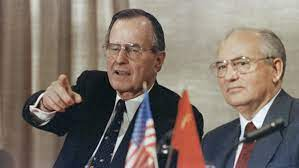
Bush and Gorbachev suggest Cold War is coming to an end
Meeting off the coast of Malta, President George Bush and Soviet leader Mikhail Gorbachev issue statements strongly suggesting that the long-standing animosities at the core of the Cold War might be coming to an end. Commentators in both the United States and Russia went farther and declared that the Cold War was over.

INVENTIONS & SCIENCE
1979
Last AMC Pacer rolls off assembly line
On December 3, 1979, the last Pacer rolls off the assembly line at the American Motors Corporation (AMC) factory in Kenosha, Wisconsin. When the car first came on the market in 1975, it was a sensation, hailed as the car of the future. “When you buy any other car,” ads said, “all you end up with is today’s car. When you get a Pacer, you get a piece of tomorrow.” By 1979, however, sales had faded considerably. Today, polls and experts agree: the Pacer was one of the worst cars of all time.

AMERICAN REVOLUTION
1776
George Washington arrives at the banks of the Delaware
In a letter dated December 3, 1776, General George Washington writes to Congress from his headquarters in Trenton, New Jersey, to report that he had transported much of the Continental Army’s stores and baggage across the Delaware River to Pennsylvania.


Comments
Post a Comment